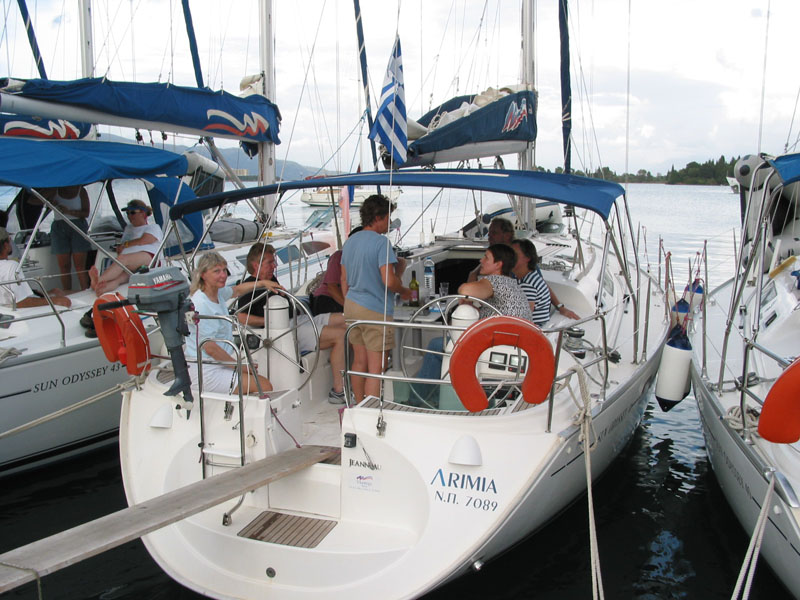
Team
Sivota, Ελλας‚ 2004
Team
Sivota, Ελλας‚ 2004
"Where's Homer" Tour
Sponsored by Mythos

|
|
|
|
Getting There - SFO to London to Corfu Wednesday, September 22, 2004 After a VERY hectic three days of preparing our lives and house construction to leave for two and a half weeks, Mike and Kelli escaped the condo at 3 p.m. on September 22, 2004 for a Greece sailing trip that was in planning for a year. One of our last errands along the way to San Francisco airport was to drop off the keys to Water Wing, our Beneteau 40CC, to Ed Pokenhorn. Ed, a Tradewinds Sailing Center instructor, would be stripping and resealing her teak while we were away. We took a cab to the El Cerrito BART station and had an easy ride to the airport. BART drops off passengers just outside the International Flights Terminal. We found a looonnngggg check-in line at British Airways. We recognized many other Tradewinds members. It took 1.25 hours to get through the line and checked in. Our 747-400 was a full flight and we caught glimpses of only a few fellow sailors. After a 25-minute delay, we were off for London Heathrow at 7:25 p.m. Mike and Kelli got some sleep after 10:00 p.m. (6:00 a.m. London time.) Thursday, September 23, 2004 The flight crew woke us at 11:30 a.m. London time and we landed at 1:00 p.m. Mike, Chuck Farrell, and Kelli took the London "Tube" (the underground rapid transit system) into the city for some sightseeing. First Stop LondonWe had a local map and decided to do some serious walking to help us adjust to the time, and find dinner (or lunch or whatever it was.) The first tourist sight was Buckingham Palace. We traversed Green Park on the way. Green Park once formed part of Henry VIII's hunting grounds. In the 17th century Charles II had the park converted into a Royal Park. The park was the site of a number of early balloon ascents and fireworks extravaganzas. During the 18th century, Green Park was also a favorite site for duels. Green Park is so-called because of the absence of flowers.
Buckingham Palace sits in a triangle of city streets, which was a surprise to Kelli (it being just stuck in the middle of the city.) The palace is one of several castles owned by the British Royal family. The original building was constructed as a country house in 1705 by the duke of Buckingham, John Sheffield. King George III bought the house in 1761 for his wife and had it altered by William Chambers. In 1826, King George IV started to expand the house into a palace. Due to a lack of sufficient funding, architect John Nash incorporated the existing house in the new palace. In 1850 the large east wing was added. It includes a large, 40-meter long ballroom. The large facade that can be seen from the Mall was built in 1913 by Aston Webb. A part of the palace is still used by the Royal family. A flag is hoisted each time the Queen is in the castle. Other parts of the castle can be visited, including the lavishly decorated state rooms. Buckingham Palace is located in Westminster, at the end of the Mall. The statue in front of the Palace is the Queen Victoria Memorial.
Leading to the Palace is the Mall.
We then wandered through St James Park towards Big Ben. St James Park is probably the most beautiful and intimate of the capital's central parks. Originally a marsh, the land was drained by Henry VIII in the 15th century to provide a deer park for St James Palace. In the 17th century, Charles II commissioned a French landscape gardener, Andre Le Notre, to convert the deer park into a garden. Charles II also had an aviary built along the southern edge of the park, hence Birdcage Walk, the street where the aviary was located. Further landscaping by John Nash, the Prince Regent's favorite, took place in the early 19th century. Now the most ornamental park in London with good views of Whitehall rooftops, St James Park is a popular place to stroll, feed the ducks or watch the pelicans. The lake is now a wildfowl sanctuary, with ducks, geese, pelicans and black swans. The bridge over it gives a view of Buckingham Palace, good at night when the palace is floodlit. The first two pictures were taken from the park bridge.
And, Westminster Abbey. The term Westminster is from the building's westerly situation from London. The Westminster Abbey is more a historical site than a religious site. Since 1066, every royal coronation, with the exceptions of Edward V and Edward VIII has taken place in Westminster Abbey. The abbey also serves as the burial ground for numerous politicians, sovereigns and artists. The abbey is stuffed with graves, statues and monuments. Many coffins even stand upright due to the lack of space. In total, approximately 3,300 people are buried in the church and cloisters. Some of the most famous are Charles Darwin, Sir Isaac Newton and David Livingstone. The history of the abbey starts in 1050, when King Edward The Confessor decided to build an abbey. Only a small part of this original Norman monastery, consecrated in 1065, survived. The only representation of this original building is shown on the Bayeux Tapestry. Most of the present building dates from the 1245-1272 period when Henry III decided to rebuild the abbey in the gothic style. Large parts were later added: the Chapel of Henry VII was added between 1503 and 1512, while the two West Front Towers date from 1745. The youngest part of the abbey is the North entrance, completed in the 19th century.
Next stop was the House of Parliament building and Big Ben. Big Ben is officially known as St. Stephen's Tower. "Big Ben" is actually the name of the largest bell inside the clock tower that forms part of the House of Parliament. It is thought that the name comes from Sir Benjamin Hall who was commissioner of works when the bell was first installed in 1858. The accuracy of the clock movement is controlled by the placing of old pennies in the mechanism. The House of Parliament is officially know as the Palace of Westminster. This building that sits on the bank of the Thames actually only dates from the 1840s. It was designed by Charles Barry and Augustin Pugin after most of the first House of Parliament burnt down in 1834. We were all in awe with the construction and delicate details of this dramatic neo-gothic building. Today the British Government is made up of the Monarch, the House of Lords and the House of Commons --both houses meet at the House of Parliament. The House of Parliament divide principally into two debating Chambers. The House of Commons comprises Members of Parliament (MPs) who are the elected representatives of the British people. Their functions are legislation and (as opposition) government scrutiny. The non-elected House of Lords is an apolitical body of the great and good, who examine proposed legislation from the House of Commons and also act as the highest Appeal Court in the Land. You can tell when the House of Commons or House of Lords are in session. A flag is flown by day and a light by night above the tower of Big Ben.
Then we strolled through the adjoining park and down to the River Thames. The Ferris wheel that you see in the pictures is the Millennium Wheel "British Airways London Eye". The creators of the Wheel are husband and wife architects David Marks and Julia Barfield. The couple had entered a competition to design a millennium landmark. No one won, and the competition was scrapped, but Marks and Barfield were convinced that their dream should be pursued. David and Julia began to piece the project together, soon attracting the attention of the London press. Then British Airways showed an interest and became a partner. The Wheel took six years to build. The Wheel is not a real Ferris wheel. Its capsules are enclosed, they are positioned on the outside of the wheel, and the whole structure is supported by an A-Frame from one side only. When you are at the top, you are 135 meters above the London skyline. The entire ride takes 30 minutes.
After crossing the Thames, we searched for, and found, a small pub with a sun room dining area in the Waterloo district at about 5 p.m. After a leisurely meal, we headed back to Heathrow. But the ride back was not as easy as the ride in. Due to switching problems, it took 30 minutes longer to get back. We got back to Heathrow and through security at 7:20 p.m. We talked with more Tradewinds sailors while we waited for our flight at 10:30 p.m. We met Mark and Laverne Hancock, who would be on our boat. Our flight departed at 10:50 p.m. As we taxied out to the runway, we saw an old Concord in its British Airways colors. On to Athens... September 24, 2004 It was a short flight to Athens -- 3.5 hours. We slept some, arriving at 4 a.m. We had to go through customs then check-in again for the flight to Corfu. We caught up with the last of our crew -- Kevin Cosentini and Sue O'Donnell at baggage claim. We arrived in Corfu at 6 a.m. under a cloudy, humid sky. Baggage claim was quick and we loaded onto the bus for the hotel. Corfu, Greece (Kερκυρας, Ελλας)Our hotel was the Hellinis. It turns out that the hotel is across from the departure end of runway 17 at the Corfu airport. So, with the non-normal winds, our rooms were noisy, but sleep was easy. Much of the culture and architecture around the island can be traced back to the long Venetian and then British rule. The town of Corfu is the largest in the Ionian Islands. The island of Corfu is the second largest of the Ionians.
We slept until noon, then walked up the hill to see the church out on Mouse Island. A host of small islands surround Corfu, most of them are only small clumps of rock. Pontikonissi (Mouse Island) is one of the best known islands in Greece. According to legend, Pontikonissi is the Phaeacian ship that brought Odysseus back to his homeland, and was turned into stone by an angry Poseidon. The monastery buildings have gone from the island, but the little Byzantine church of Pantokrator (11th or 12th century) still stands. This small church is the only building on the island. Pantokrator means "Creator of All."
We walked the pedestrian bridge that is right under the approach path for the runway 35. The runway approach light, in the first picture, is right at the pathway.
We got some Cokes at the local minimart and relaxed at the hotel pool with other Tradewinds sailors. We met our crew at 6 p.m. and had dinner at 7:30 up the hill at the Captain's taverna -- our first Greek food. Friday, September 24, 2004 Kelli left for skippers' orientation at 9:30 a.m. At the meeting, skippers got charter information, a route briefing and rules review, and filled out paperwork. Skippers had to turn in their passports and that of their first mates... and a credit card. After our passports were checked and our credit cards cleared, we got everything back. Our boat, Didimos, was not ready after the meeting. Didimos had been returned that morning and the Moorings staff needed time to check-in, clean, and fuel the boat. The bus with the remainder of the Tradewinds sailors arrived at 12:45. The crews headed for the marina market to do provisioning. Mike came over to help with the inventory check and checkout. It took until 3:30 p.m. to finish the checklist and get a few missing items. The rest of the afternoon was spent settling in and cocktailing. The guys went wine shopping twice at a local liquor store. We had dinner at an outdoor "locals" restaurant. It started to rain just as we finished our meal. It rained all night.
|
|||||||||||||||||||||||||||||||